


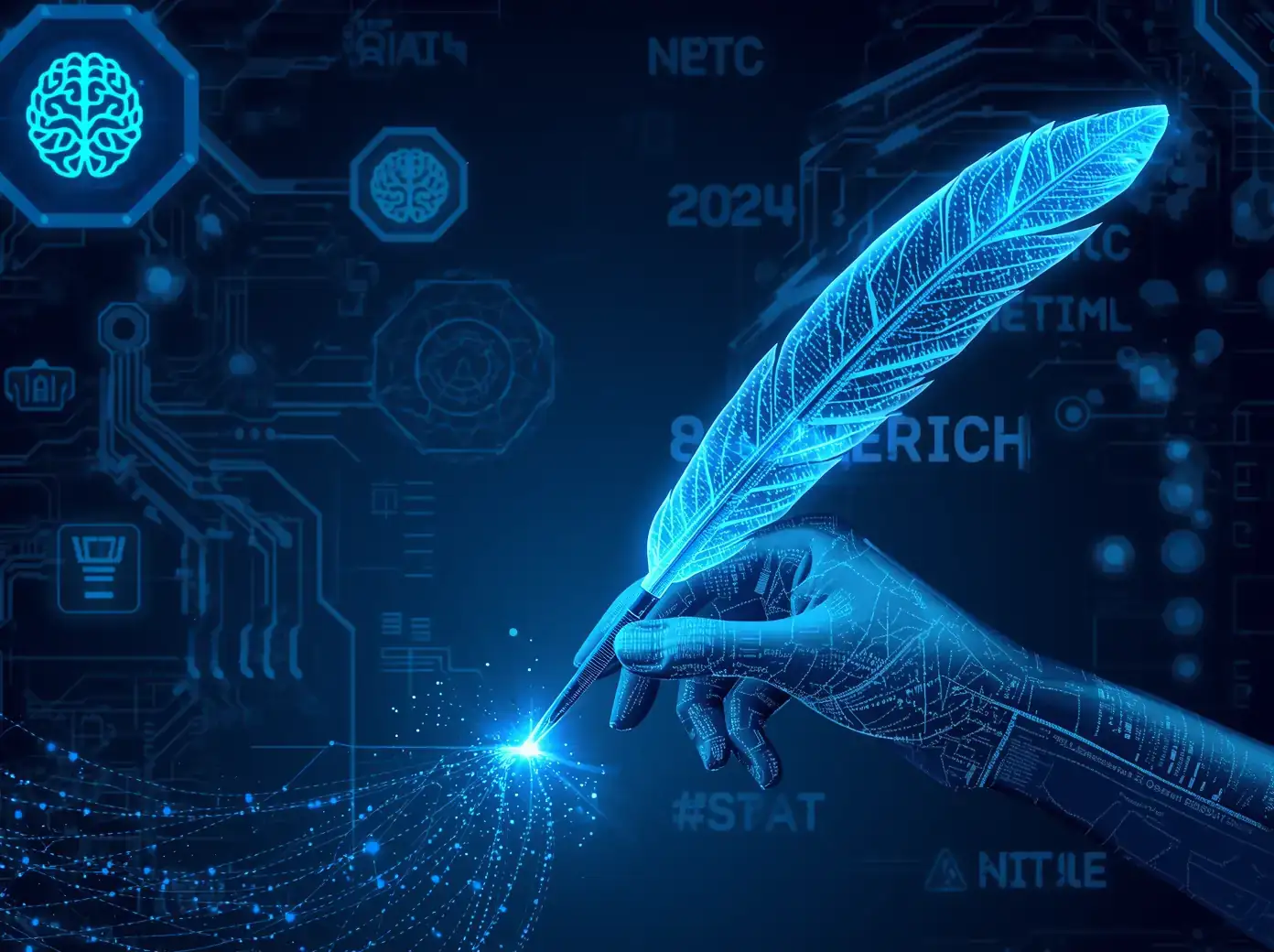
The landscape of creation is shifting dramatically. For centuries, the “author” was a figure defined by their mastery of language—the sentence forged through painstaking effort, the narrative sculpted by an innate understanding of human experience. Today, that definition is being challenged by a potent new collaborator (or competitor, depending on your perspective): Artificial Intelligence. This technological revolution has ignited a “cold war” in the literary world, pitting the perceived sanctity of the “true author” against a growing contingent of writers, like myself, who leverage AI to bring their stories to life, often because we lack the traditional, hard-won toolkit of literary mastery.
At the heart of this conflict lies a profound ethical question: When a story is co-authored by human intention and algorithmic execution, where does the value truly reside? Does the digital quill diminish the worth of the narrative it helps create?
The Ethos of the “True Author” vs. The Accessible Muse
The traditionalist viewpoint holds that the essence of great writing lies in the struggle, the intimate wrestling with words and syntax that transforms a mere thought into resonant prose. To master the sentence is to master a craft that demands years of dedication, reading, and relentless revision. The “true author” derives their authority—and the value of their work—from this very mastery.
When AI steps in, offering to generate, refine, or even structure an entire narrative, it appears to bypass this necessary struggle. For writers who do not possess the innate or cultivated “tool set”—be it a natural fluency, grammatical precision, or the sheer time required for extensive drafting—AI is a powerful equalizer. It offers a bridge between a brilliant concept and a readable, compelling final product. For us, the AI is not a replacement for creativity, but an essential extension of it, an interpreter that translates high-level ideas into functional language.
The core question we face is: If the idea and the emotional core—the narrative engine—remain profoundly human, does the assistance provided by a machine for syntax and flow render the story inherently less valuable?
I argue that it does not. The true value of a story lies in its ability to evoke emotion, transport the reader, and offer a unique perspective. If an AI helps a writer articulate a deeply personal, impactful, or necessary story that would otherwise remain trapped as an unformed concept, that story’s value is, in fact, increased by its very existence. The craft shifts from solely mastering the sentence to mastering the prompt and the refinement—a collaborative curatorial skill that is no less intellectually demanding.
The Problematic Profit-Seeker
Any discussion about AI in writing must acknowledge the unfortunate, yet prevalent, shadow cast by those who operate without integrity: the unprincipled generators. These individuals view AI purely as a churn mechanism—a means to rapidly produce a flood of mediocre, formulaic, and often repetitive text solely for quick financial gain. Their objective is not storytelling or artistic expression, but optimizing for market niches and search engine results.
This sheer volume of low-quality, AI-generated content pollutes the literary ecosystem, making it harder for readers to find genuine voices, whether those voices are purely human or AI-assisted. This practice rightly draws ire and fuels the narrative that AI inherently leads to the devaluation of writing. However, it is crucial to distinguish between the ethical, intentional use of AI to overcome personal limitations and the cynical, volume-based exploitation of the technology. The fault lies not with the tool, but with the intent of the user.
The Ethical Imperative of Licensed Training Data
The current power and utility of generative AI models stem directly from their training data—a colossal body of work comprising billions of texts, including countless copyrighted novels, articles, and poems. This practice has understandably led to significant legal challenges, often framed as a violation of intellectual property and an infringement on the rights of living artists.
While the sheer scale of the training data has led to capable models, it is ethically and legally indefensible to assert that the end justified the means. The extensive use of protected, high-quality work without explicit permission or compensation represents a fundamental violation of creators’ rights, regardless of the resulting technological advancement.
To develop an AI capable of producing prose with nuance, voice, and grammatical sophistication, it had to learn from the very best examples of human linguistic output. However, asserting that this required unauthorized use sets a dangerous precedent. Restricting the training corpus to only public domain or explicitly licensed content might have initially resulted in models that were slower to develop or required more targeted investment, but this would have upheld the foundational rights of creators. The true measure of technological innovation should be its ability to succeed within established legal and ethical boundaries, not by bypassing them.
The current legal and ethical challenge is how to justly compensate the creators whose work was already used without permission. The future must focus on a stricter adherence to intellectual property rights, making licensed data the new standard, and retroactively establishing fair compensation for the unauthorized use that made this leap possible.
Redefining Value in the Age of Collaboration
Ultimately, the value of a story is subjective, but it is intrinsically tied to impact and originality. If an AI helps a writer without the conventional “toolkit” produce a novel with a powerful, original plot, compelling characters, and deep emotional resonance, that work has immense value.
The “cold war” between the purists and the adopters needs to evolve into a nuanced acceptance of collaboration. Mastery of the sentence may forever define one path to authorship, but mastery of the narrative idea combined with the skillful direction of AI defines a legitimate, necessary second path.
For those of us using AI, our stories are not “less valuable.” They are testaments to a new era where the barrier to entry for complex creative expression is lowered. Our contribution lies in the concept, the structure, the refinement, and the human heart we imbue into the machine’s output. The true author of the future may be defined less by their perfect prose and more by their extraordinary vision, articulated through whatever means necessary—even if that means wielding a digital quill.